
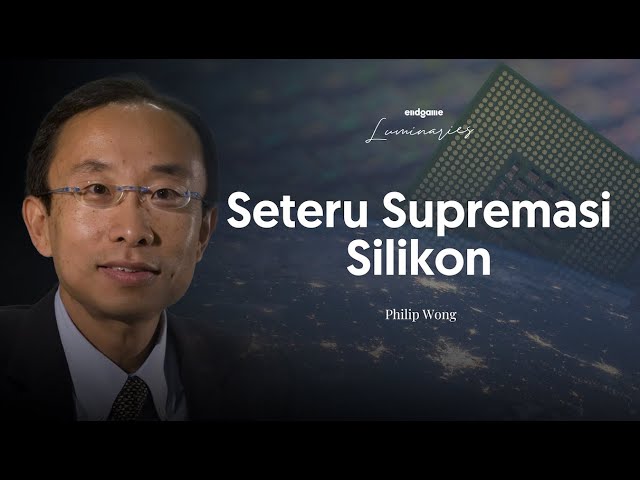
Chips have been playing a central role in modern societies across the globe. From airplanes to smartphones; from defibrillators to factory robots. It is everywhere. Therefore, it is hard to imagine a world without it. The advancement of chips—and thus humanity—will only be possible if, and only if, open science and international cooperation continue to persist. With the current geopolitical turmoil, who is going to pay the cost of chip innovation slow-down? Philip Wong is a Willard R. and Inez Kerr Bell Professor in the School of Engineering, at Stanford University. He was the Vice President of Corporate Research at TSMC (2018—2020) and has remained the Chief Scientist of TSMC in a consulting and advisory role. Prior to Stanford, he was with the IBM T.J. Watson Research Center for almost two decades (1988—2004). Professor Philip Wong discusses the potential of advanced manufacturing and the role of AI in accelerating innovation. He emphasizes the importance of talent cultivation and collaboration in driving technological advancements. Wong highlights the need for open science and global supply chains for progress in the semiconductor industry.
🔍 The semiconductor industry’s exponential progress is driven by both increasing demand and continuous innovation. This trend is expected to continue in the future.
🔍 Talent cultivation and societal support play a crucial role in the success of semiconductor companies. Companies like TSMC have benefited from a strong talent pool and supportive environment.
🔍 Singapore, Korea, China, and India are emerging as strong contenders in the semiconductor industry, indicating a shift in global innovation dynamics.
🔍 Policymakers need to have a deep understanding of the semiconductor industry to ensure effective support and avoid hindering progress.
🔍 Open science and global supply chains are essential for advancements in the semiconductor industry, enabling collaboration and knowledge sharing.
🔍 The rise of research capabilities in Asian countries is reshaping the global innovation landscape, leading to increased competition and collaboration among nations.
🔍 The inseparable relationship between manufacturing and R&D highlights the importance of investing in both areas for sustained technological advancements.




 EXTERNAL GAZER
Leave a comment